


English
Subject Information
Knowledge Organisers
Progression of Skills
Progression of Skills - English
Phonics
The Phonics Screening Check
The Phonics Screening Check
Children complete the Phonics Screening Check towards the end of Year 1 so parents can be confident that their children are learning to read successfully.
Children read 40 real and pseudo words – the check is carried out a familiar adult and usually takes between two and five minutes.
Traditionally 32 is the mark that indicates if a child has reached the standard of the check. Any children who do not meet this standard will continue to receive phonics teaching and support and will be re checked towards the end of Year 2.
The mark of 32 is subject to change by the Department of Education and schools are notified of any change in late June.
All children are supported to learn phonics using the Active Learn Phonics Bug Programme.
Phase 2 Phonics Actions
Phase 3 Phonics Actions
Phase 4 Phonics Actions
Learning at home
Reading
The importance and benefits of reading:
Research shows that reading helps to improve vocabulary, communication skills and also makes us better writers. We all need these skills in life and in our workplace. Consider talking to your child about when you use these skills in your own life and work. The increase in screen-time and social media has been shown to have decreased our focus and concentration levels as people are so used to flicking between apps and scrolling through various websites. Reading can help counter this by providing one thing to focus on. Did you know that reading has been proven to reduce stress? In today’s world, helping our children with this is so important.
Did you know that research shows children who read for pleasure achieve better, regardless of whether their reading material of choice is a novel or magazine? Please do encourage your child to read a variety of texts that they are interested in. Did you know research shows that a child who reads/is read to for 5 minutes a day will expose them to around 400,000 words a year? Increasing that to 21 minutes exposes them to 1,823,000 words a year. 40 minutes results in 3,646,000 words a year.
Suffolk Libraries
Why not join the library?
follow the link to join the library:
Joining the library (suffolklibraries.co.uk)
You can access thousands of free Libby App and Audio Books on Borrowbox:
Borrow & Download Books, eBooks, eMagazines - Suffolk Libraries
Magazines and newspapers are great to encourage reading and Suffolk Libraries offer a range of free titles about music, sports and more on the Press Reader app:
Borrow & Download Books, eBooks, eMagazines - Suffolk Libraries
Featherbed Tales
Featherbed tales lets you share beautiful stories brought to life with your own voice! Perfect for children developing their language skills and this is free from Suffolk Libraries:
Parenting - Advice, Resources & Support - Suffolk Libraries
Our Community Library
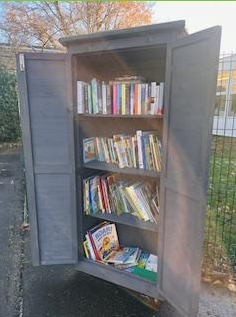
It has been wonderful to see so many families using our community library. With our philosophy of "Take a book, return a book", it means that the titles are ever changing. If the door is ever shut don’t be put off – open it and see what might grab you!
Book Suggestions
If you’re looking for book suggestions, you may like to explore bookheads.org.uk or schoolreadinglist.co.uk for booklists, or visit a site like www.barringtonstoke.co.uk which produces books for reluctant, less confident and dyslexic readers.
Have a look through the Non-Fiction November booklet - there are plenty of ideas to enjoy with friends and family!
Remember you can borrow non-fiction texts from our school library, the community library (by the school kitchen) or any Suffolk Library.
Rollama and SPaG.com
Speak to your class teacher if you have lost your login details:
- Rollama is a llama-themed universe of mini-games and teaching tools for spelling, punctuation, and grammar, with medals, leaderboards, avatars, competitions, and more!
- SPaG.com - for year 5 and 6 pupils - it offers grammar and punctuation tests for children to complete online
Phonics
Please practise the phonemes that pupils are taught at school.
Phonics improves the accuracy of the child's reading but not necessarily their comprehension. It is important that children are successful in making progress in all aspects of reading including comprehension and the development of vocabulary.
Please see videos that support correct pronunciation.
Phase 5 action videos
Letter Formation Videos
Book Reviews
KS2

